Imagine a narcotics unit in central India collating data on an organized drug network. Within a few days of digital surveillance, they are sitting on a vast pile of audio clips. After intercepting 847 calls from forty-three different SIM cards, few voices kept repeating sign that they are key players in the criminal network. The kingpin’s voice was distinctly calm, directive always brief. This situation was not just a figment of imagination restricted to narcotics unit in central India. It’s the practical challenge faced by investigating agencies across the country every day.
All call recordings were short by design proof that callers were careful about being recorded. Rarely did a call last more than ninety seconds. Each call was placed from a different number, many of them pre-activated SIMs procured through street level agents with no verifiable identity trail. The network had learned from past arrests: never use the same number twice, never say anything explicit, and never stay on long enough for a trace. By the time investigators manually reviewed the first two hundred recordings, three weeks had passed. The voice giving instructions, adjusting routes, signaling go-aheads with single words had appeared in calls originating from four different districts. But without a name, a face, or a matched number, there was nothing investigators could produce conclusively in court.
Voice recognition teams in law enforcement agencies are facing the “problem of plenty” in the digital age. In the previous decade, investigating teams struggled to secure just one audio clip as clinching evidence. Today, teams are drowning in data struggling with separating relevant information from the noise of thousands of recordings.
Voice recognition and conversation interpretation are key tasks performed by investigators gathering audio evidence. Voice recognition is crucial evidence in proving the identity of the speaker. Interpretation is necessary to ensure relevance of conversation so that it proves either a conspiracy, collusion or crime.
Delegating speaker recognition to AI tool
For decades, law enforcement agencies investigating organized crime relied on human ears analysts who would listen to hundreds of hours of wiretapped phone calls, painstakingly trying to match voices across recordings. Today, artificial intelligence has transformed that process entirely. Speaker recognition technology now sits at the heart of some of the world’s most complex criminal investigations, enabling investigators to link individuals across thousands of intercepted communications with a speed and accuracy no human analyst could match.
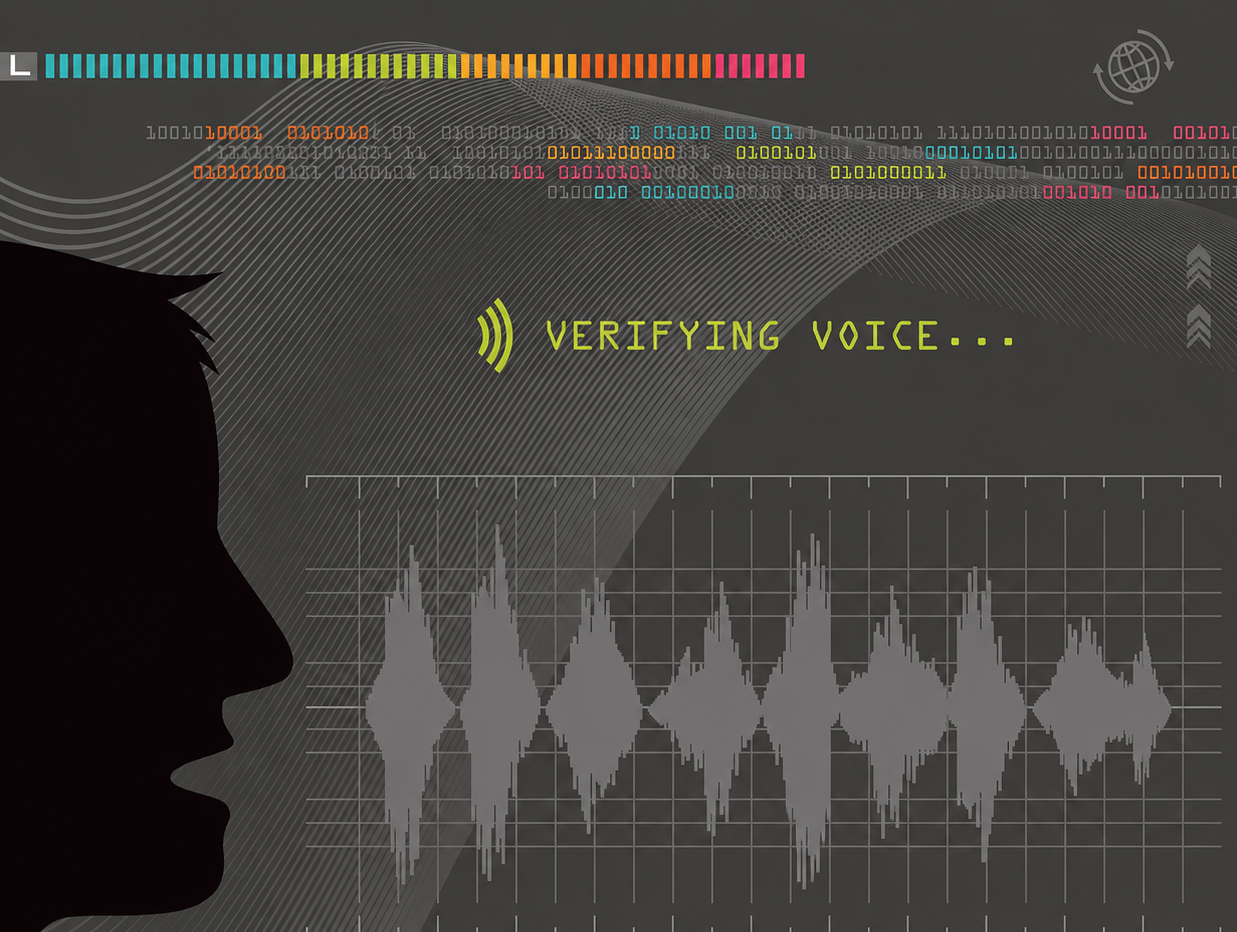
Voice identification or speaker verification is the automated process of identifying or confirming the identity of a person based on characteristics unique to their voice. Unlike speech recognition, which converts spoken words into text, speaker recognition focuses on who is speaking rather than what is being said. Every human voice carries a distinct acoustic fingerprint, shaped by the size and shape of the vocal tract, the density of the vocal cords, articulation habits, regional accent, and even emotional cadence. AI systems extract these features from audio and convert them into a mathematical model called a voiceprint a high-dimensional vector that uniquely represents a speaker’s vocal identity.
Modern speaker recognition systems are built on deep neural networks trained on millions of voice samples. These models learn to map audio segments into an embedding space, where recordings from the same speaker cluster together and recordings from different speakers remain well separated. When investigators feed a new audio sample into the system, it generates an embedding and compares it against known voiceprints in a database returning a similarity score that quantifies the probability of a match.
Voice recognition in tracing organized crime network
In organized crime investigations, law enforcement agencies typically operate under court-authorized wiretapping orders that allow them to intercept telephone communications over weeks or months. A mid-scale investigation into a drug trafficking network can generate thousands of call recordings. Without automation, the task of identifying who is speaking in each call is overwhelming. AI speaker recognition systems process these recordings systematically. First, they perform speaker diarisation segmenting each call into speech turns and labeling each segment by speaker identity. This tells analysts exactly when each participant is speaking, even in overlapping conversations or noisy environments. Next, the system clusters unknown voices across all intercepts. If a particular voice appears in forty different calls some made from burner phones, others on encrypted messaging apps the AI links them together without investigators needing to know the speaker’s identity in advance. These clusters become working identities, referred to internally as “Unknown Speaker 1,” “Unknown Speaker 2,” and so on.
When a known voice sample becomes available perhaps from a police interview recording, a public speech, or a previously identified suspect investigators compare it against these clusters. A high similarity score confirms a match. In this way, a single identified voiceprint can illuminate an entire network of previously anonymous calls. Critically, the quantum of audio recordings isn’t a major challenge because AI can decipher and identify voice from hours of recordings.
When voices have been deliberately altered using pitch-shifting tools, AI systems analyze features beyond fundamental frequency including formant patterns, spectral envelope characteristics, and speaking rhythm that are harder to mask. While heavy distortion remains a significant challenge, even partially altered recordings often yield usable evidence. Investigators increasingly work with audio extracted from seized devices voice notes sent over messaging apps, video files captured on phones, ambient recordings made during meetings. Speaker recognition applies equally to these sources, binding digital artifacts to known individuals within a case.
Using AI tools, Investigators can build what is sometimes called a voice network graph a visualization of who speaks with whom, how frequently, and in what context. When combined with metadata analysis (call timing, duration, geographic location of devices), this graph reveals the organizational hierarchy of a criminal network: who gives orders, who receives them, and who serves as intermediaries.
In terrorism and transnational organized crime cases, intelligence agencies share voiceprint databases across jurisdictions. A speaker identified in an intercepted call in one country can be matched against a voiceprint collected during a surveillance operation in another, linking operatives who have never been physically observed together. These vital links can be crucial in tracking serious crimes like terrorism, hawala operations and even insider-trading