Extracting relevant information from chaotic audio
In 1987, the Fraunhofer Institute for Integrated Circuits IIS-A in Germany developed a technology to compress audio files so that it can be quickly and cheaply transmitted for commercial purposes. The MP3 format was devised using psychoacoustic masking to achieve nearly 11-to-1 compression ratios while remaining extremely faithful to the original sound.
The basic theory behind psychoacoustic masking is that the human ear will not detect certain frequencies in a sound wave if they will be overpowered by energy at different frequencies. Since the sound won’t be heard, it is discarded, allowing MP3 files to be smaller in size without compromising quality. MP3’s became the favourite of music lovers as it offered CD-quality sound that can be stored easily. An average song took just about 3 to 5 megabytes of space. By stripping sounds that a human ear can’t hear, MP3 achieved remarkable efficiency. With a small size and easy usage, it became widely accessible at a global level.
The anatomy of sound
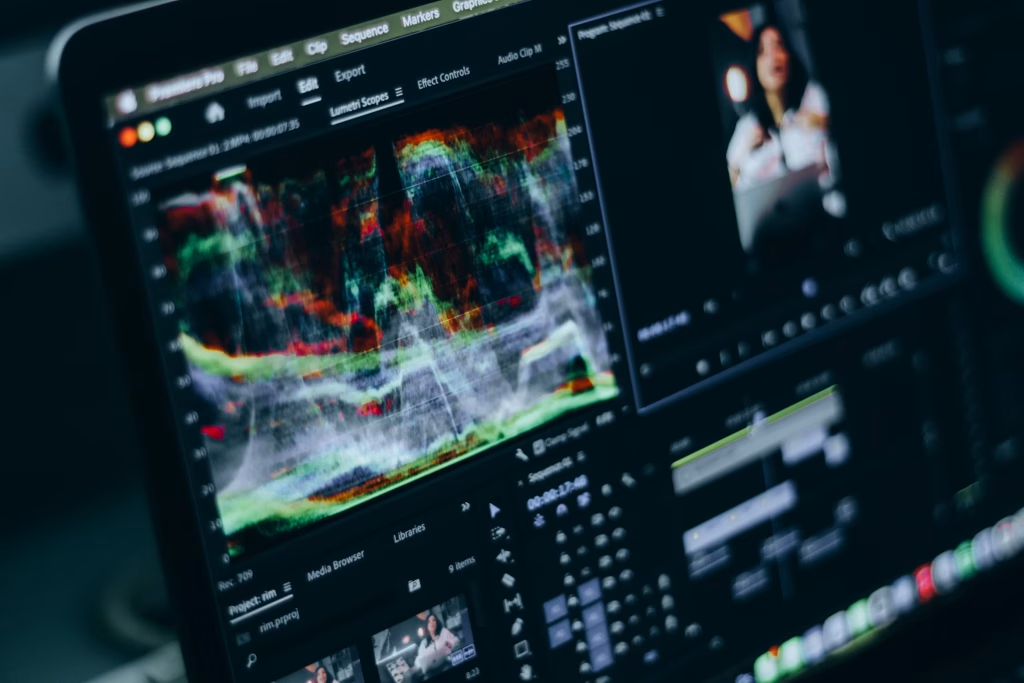
As per the National Center for Biotechnology information of US Government, Humans can detect sounds only in a frequency range from about 20 Hz to 20 kHz. Beyond this narrow audible spectrum, the human ears can neither hear nor make sense of sound. Whether it’s music or surveillance videos, technology captures frequencies that are indecipherable to humans. Apart from frequency issue, audio recordings from a chaotic scene say a busy marketplace or a crime scene can be difficult to comprehend. With advancements in AI, noise reduction technology that can reduce ambient noise can help eliminate unwanted background noise from any video, podcast recording or CCTV records. By converting an audio waveform into a Spectogram that depicts frequencies of sound and changes over time, AI can highlight relevant frequencies crucial for speech recognition, effectively filtering out the disruptive noise aka sound that is inaudible to the human ears. Spectogram can isolate an audio file into discrete units for processing independently.
Neural noise reduction engines that requires significant processing capabilities and AI can convert messy content into a studio-quality audio which has applications in media, entertainment and law enforcement sector. It also has applications in real-time streaming of crowded places like religious events in public spaces or content creators live from the chaotic streets.
Extracting audio for justice
One of the most sought-after application of AI audio processing is the extraction of relevant sound for law enforcement agencies. Whether it’s a terror attack or a riot-like situation or a peaceful mob, the footage of the scene are chaotic and the audio is noisy. Justice can’t be delayed by noisy audio. Law enforcement agencies and judiciary won’t wait for tedious post-processing before dispensing justice. Clarity is a prerequisite before judging anyone guilty or acquitting any suspect. Crime scene surveillance cameras capture audio and visuals from the spot but cannot be submitted in the court of law without adequate safeguards. There is a looming threat of deepfake audio and video in every digital evidence examined by the judiciary. Speech recognition models and speech clarity apps are required to filter unnecessary information without harming the integrity of the media. Apart from use by the civilian government, AI is useful for covert operations and military uses. Intelligence agencies with assets operating in far-off land need capabilities like sound detection and transmission to carry out espionage operations and counter-terror activities. Special forces operating clandestinely require state-of-the-art audio devices to coordinate with each other on troop position amidst the chaos of operation. Any misinformation or noise during sensitive operations can lead to confusion resulting in loss of lives.
As advances in AI makes voice cloning easy and cheap, the sound extraction capabilities of companies and government should rise proportionately in order to ensure usefulness and authenticity of audio data. Misinformation campaigns are potent if real video visuals are combined with fake audio to lend credence to the propaganda. Whether it’s a war scenario or peaceful law and order situations, extracting relevant information is the cornerstone of data. Chaotic audio or noisy surroundings have been a long-standing hindrance to sound quality. AI is set to permanently solve the problem.